
Sapphire: The Celestial Gem of Wisdom and Truth
👑 The Azure Monolith: A Preamble on the Enduring Majesty and Cosmic Resonance of Sapphire
 In the vast, glittering hierarchy of the earth’s treasures, few stones command the silent, immutable reverence held by the sapphire. It is a gem that does not merely reflect light; it seems to absorb and condense the very essence of the infinite. To gaze into the heart of a perfect blue sapphire is to confront a piece of compressed eternity—a tangible fragment of the night sky, fallen to earth and hardened by geological time. It is a phenomenon that transcends mere mineral composition, existing instead as a profound intersection of chemistry, mythology, and human aspiration. For millennia, this celestial blue has been the colour of the divine, the hue of ultimate authority, and the universal signature of deep, abiding truth.
Before it became the centerpiece of the most celebrated engagement rings or the weightiest of crown jewels, the sapphire was a religious and philosophical anchor. Ancient civilizations, gazing up at the deep azure of the daytime sky or the velvet indigo of the cosmos, saw the sapphire as the literal mirror of the heavens. They believed the earth itself was set upon a colossal sapphire, whose brilliant reflection gave the sky its colour—a spectacular, unifying vision that elevated the stone above all others. This profound, cosmic association instantly imbued the gem with a unique, unassailable authority. To possess a sapphire was to possess a piece of the divine canopy, to wear the protection of the gods, and to carry the very wisdom of the cosmos against one’s skin.
This is why its history is not recorded in the ledgers of commerce, but in the most sacred and powerful artifacts of mankind. The stone’s journey is traced through the rings of high priests, the scepters of emperors, and the foundational myths of multiple cultures.1 It was the legendary stone of King Solomon, worn by him for protection and wisdom. It was believed by the ancient Greeks to be the stone that conferred light and spiritual sight, capable of guiding its wearer to truth and prophecy. For the medieval Christian church, the blue sapphire symbolized spiritual purity, chastity, and heavenly grace, making it the preferred gemstone for ecclesiastical rings—a literal, personal touchstone to the kingdom of heaven. Its enduring presence in the most hallowed contexts—from the breastplate of the High Priest of Israel to the reliquaries of European cathedrals—is a testament to its singular power as a spiritual conduit.
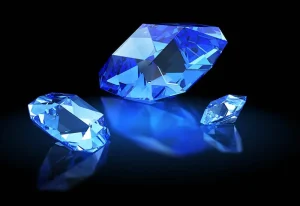 The majesty of the sapphire, however, extends far beyond its symbolic blue. The term ‘sapphire,’ derived from the Greek sappheiros meaning “blue stone,” is in fact a wonderfully misleading simplification. In its full glory, the sapphire family encompasses a breathtaking rainbow of colors, known in the trade as “Fancy Sapphires.” These include the vibrant hues of pink, the blazing brilliance of yellow, the subtle shift of violet, and the mysterious depth of green.2 Every sapphire, regardless of its hue, is a variety of corundum, aluminum oxide (3$\text{Al}_2\text{O}_3$), a compound whose crystalline strength is second only to that of the diamond.4 The very process of its creation—the slow, high-pressure fusion of elements deep within the Earth’s crust—results in a mineral of extraordinary durability, registering a formidable 9 on the Mohs scale of hardness.5 This physical permanence perfectly echoes its symbolic endurance. A sapphire is not a fleeting pleasure; it is an inheritance, a stone designed to last through ages.
Yet, it is the trace elements, the invisible architectural accidents, that are responsible for the stone’s palette.6 A whisper of chromium (7$\text{Cr}$) yields the rose of a pink sapphire.8 A combination of iron (9$\text{Fe}$) and titanium (10$\text{Ti}$), locked in a delicate dance of Intervalence Charge Transfer, creates the classic, electrifying blue.11 This geological narrative underscores the rarity and prestige of the most celebrated color variant: the Padparadscha sapphire. Named after the Sinhalese word for ‘lotus blossom,’ this exquisite stone combines the soft pink of a morning sky with the fiery orange of a setting sun—a delicate, evocative blend that is amongst the most coveted and valuable gems on Earth.12 The rarity of its perfect color combination elevates it to an almost mythical status, proving that the sapphire’s appeal lies not only in power, but in the delicate artistry of nature.
The symbiotic relationship between the sapphire and human royalty is perhaps the most visible chapter of its story. From the ancient Persian kings who adorned their thrones with the deep blue stone to the modern British monarchy, the sapphire has been the ultimate visual declaration of power, integrity, and eternal commitment. It is a stone that cannot be compromised; its clarity and depth reflect the very virtues expected of a noble ruler: sincerity and faithfulness. Its famous modern revival, ignited by the selection of a Ceylon sapphire for Princess Diana’s engagement ring, which now graces the hand of the Princess of Wales, Catherine, cemented the stone’s modern identity.13 It is now the jewel of choice for those who seek to convey a love that is both passionate and timeless, a legacy that is both deeply personal and enduringly public.
The stone’s appeal is, therefore, a confluence of profound factors: cosmic symbolism, geological rarity, and a history steeped in regal and spiritual authority. It is a talisman of travelers, a protector against envy, and a silent promise of loyalty.14 To fully appreciate the sapphire is to understand that you are holding more than a mineral; you are holding an artifact of Earth’s deep past, a vessel of human belief, and a brilliant, tangible mirror to the heavens.
The following guide invites you to explore this majestic world: the legends that birthed its reputation, the geological processes that formed its spectacular colors, and the monumental, famous stones that have defined its prestige across the globe.
 The sapphire is perhaps the most universally beloved and culturally significant of all colored gemstones. While the term generally evokes an image of a deep, celestial blue, the sapphire is actually the name given to gem-quality corundum of any color other than red (which is a ruby).
Recognized as the gemstone of wisdom, nobility, sincerity, and faithfulness, sapphire has long adorned the sacred artifacts of churches and the regalia of royalty, earning its reputation as a majestic and enduring jewel.
This comprehensive guide explores the rich heritage, geological formation, diverse colors, and the spectacular, famous sapphires that define its prestige.
📜 History, Mythology, and Symbolic Meaning of Sapphire
The reverence for sapphire stretches back to ancient civilizations, where its color was linked directly to the heavens.
Ancient Lore and Royal Protection
The Color of Heaven: The name sapphire is derived from the Greek word sappheiros, meaning “blue stone.” Ancient Persians believed that the Earth rested on a giant sapphire whose reflection painted the sky blue.
The King’s Stone: In ancient Greece and Rome, kings and queens wore blue sapphires, believing the gem protected them from envy, harm, and attracted divine favor. Roman scholar Pliny the Elder wrote that the gem’s intense blue was “the image of the starry heavens.”
A Symbol of Faith: During the Middle Ages, the Christian clergy cherished sapphires as symbols of heaven and spiritual purity, often wearing them in ecclesiastical rings. It was also believed that sapphire could protect the wearer from illness and evil spirits, and even reconcile enemies.
The Talisman of Travelers: The 19th-century British explorer Sir Richard Francis Burton carried a large star sapphire throughout his journeys. He believed its asterism (the star effect) was a talisman that would bring him luck and safety.
Modern Royal Legacy
The sapphire experienced a massive resurgence in modern popular culture when Britain’s Prince Charles gave a 12-carat oval Ceylon sapphire engagement ring to Lady Diana Spencer in 1981. The ring, now worn by Catherine, the Princess of Wales, cemented the sapphire’s status as the ultimate symbol of royal romance and enduring legacy.
🔬 Sapphire Geology: Corundum and Chromophores
Sapphire is, chemically, aluminum oxide ($\text{Al}_2\text{O}_3$), a variety of the mineral corundum. Its remarkable hardness (9 on the Mohs scale, second only to diamond) makes it incredibly durable for jewelry.
The Cause of Color
Pure corundum is colorless. The vast spectrum of sapphire hues is caused by trace elements, known as chromophores, that are trapped within the crystal lattice during its formation deep within the Earth’s crust.
Blue Sapphire: The iconic blue color is caused by the co-presence of trace amounts of iron ($\text{Fe}$) and titanium ($\text{Ti}$). The color is produced by a quantum mechanical phenomenon called Intervalence Charge Transfer (IVCT), where an electron transfers between the adjacent iron and titanium ions, absorbing yellow light and allowing the complementary blue light to be transmitted.
Pink Sapphire: Pink hues are caused by trace amounts of chromium ($\text{Cr}$), the same element that causes the red in ruby. The distinction between a pink sapphire and a ruby is one of hue saturation and tone, with the redder, more intense stones classified as rubies.
Yellow/Green Sapphire: These colors are primarily caused by different concentrations and states of iron.
The Rarity of Padparadscha
One of the rarest and most collectible hues is the Padparadscha sapphire. This beautiful and unique color is a delicate blend of pink and orange, reminiscent of a lotus flower at sunset. The name derives from the Sinhalese word for “lotus blossom.” Authentic, natural Padparadscha stones command exceptional prices.
🌎 Principal Occurrences of Sapphire
Sapphire deposits are generally found in metamorphic rocks (like marble) or igneous rocks (like basalt), or in secondary alluvial deposits left by ancient rivers.
| Source | Key Color Characteristics | Geological Type | Rarity & Value |
| Kashmir | Velvety, intense “Cornflower Blue” due to minute silk-like inclusions. | Metamorphic (Marble-hosted) | Extremely Rare. The finest and most valuable. Production is virtually non-existent today. |
| Sri Lanka (Ceylon) | Lighter, brighter, often more vivid blue; also produces many “fancy” colors. | Alluvial (River gravels) | Historic & Important. Known for high clarity and is the source of many famous large stones. |
| Myanmar (Burma) | Deep, saturated “Midnight Blue,” often with a beautiful, rich hue. | Metamorphic | Highly sought after for its rich color saturation. |
| Madagascar | Wide color range from violet-blue to pink and yellow. | Metamorphic and Alluvial | Major Modern Source. A global leader in current production. |
| Australia | Darker, inky blue, often used for smaller, calibrated stones; also produces Parti Sapphires (bi-color). | Igneous (Basalt-hosted) | Reliable commercial source, known for durability. |
👑 The World’s Most Famous Sapphires
The history of sapphire is punctuated by massive, flawless gems that have become part of royal collections and major museums.
The Star of India (563.4 carats): Discovered in Sri Lanka (Ceylon) and donated to the American Museum of Natural History. It is one of the largest and most famous star sapphires in the world, renowned for its distinct, sharp asterism.
The Logan Sapphire (422.99 carats): Housed at the Smithsonian National Museum of Natural History, this is one of the largest faceted blue sapphires in the world. It is celebrated for its deep blue color and exceptional clarity, set in a brooch surrounded by 20 diamonds.
The Rockefeller Sapphire (62.02 carats): A magnificent rectangular step-cut gem of Burmese origin, known for its superb, highly saturated blue color. It was originally purchased by John D. Rockefeller, Jr. in 1934 and has sold at auction for record prices.
The Stuart Sapphire (104 carats): A large, deep blue, oval-shaped gem that is part of the British Crown Jewels. Its history traces back to the 17th century, and it is set on the back of the Imperial State Crown.
The enduring charm of the sapphire lies not only in its mesmerizing blue, but in the rich tapestry of human history, aspiration, and romance it
Frequently Asked Questions
1. What causes the different colors found in sapphires? While pure corundum is colorless, the various hues of a sapphire are caused by trace elements, or “chromophores,” trapped in the crystal lattice. For example, the combination of iron and titanium creates the classic blue color through a process called Intervalence Charge Transfer. Chromiumproduces pink hues, while different concentrations of iron result in yellow or green sapphires.
2. How durable is a sapphire compared to other gemstones? Sapphires are exceptionally durable, making them ideal for jewelry intended to last for generations. They are composed of aluminum oxide () and register a 9 on the Mohs scale of hardness. This makes the sapphire the second hardest natural mineral, surpassed only by the diamond.
3. What is a “Padparadscha” sapphire, and why is it special? The Padparadscha is one of the rarest and most coveted varieties of sapphire. Named after the Sinhalese word for “lotus blossom,” it features a unique, delicate blend of pink and orange. Its rarity and evocative color—reminiscent of a sunset—elevate it to an almost mythical status among collectors.
4. Why was the sapphire historically associated with the divine and the heavens? Ancient civilizations linked the sapphire’s deep blue color to the sky and the cosmos. The Persians believed the Earth rested on a giant sapphire that reflected its color onto the sky. In the Middle Ages, the Christian church viewed the stone as a symbol of spiritual purity and heavenly grace, leading high-ranking clergy to wear them in ecclesiastical rings as a “touchstone to the kingdom of heaven.”
5. Which famous sapphire is currently part of the British royal family’s modern legacy? The most iconic modern sapphire is the 12-carat oval Ceylon sapphire engagement ring originally chosen by Lady Diana Spencer in 1981. This famous stone, which helped reignite global interest in the gem, is now worn by Catherine, the Princess of Wales.